Customer Relationship Management (CRM) systems have become a core investment for modern businesses. With advanced features like AI automation, predictive analytics, and omnichannel support, CRM platforms offer powerful tools to increase revenue and efficiency. However, companies must measure CRM ROI (Return on Investment) to understand whether the system delivers real business value. Measuring ROI helps justify CRM costs and ensures the platform contributes to business growth.
CRM ROI measurement is especially important because it helps businesses identify which features and workflows provide the most value. By tracking performance, companies can improve processes, allocate budgets effectively, and maximize CRM benefits. This ensures CRM is treated as a strategic investment rather than just an operational expense.
One of the most important metrics for CRM ROI is Customer Lifetime Value (CLV). CLV represents the total revenue a customer generates throughout their relationship with a company. CRM systems help track customer behavior, purchases, and engagement, allowing businesses to calculate lifetime value more accurately.
Customer Acquisition Cost (CAC) is another key metric. CAC measures how much it costs to acquire a new customer. CRM platforms improve lead management, automate follow-ups, and increase conversion rates, which helps reduce acquisition costs and improve ROI.
Churn rate is also critical for measuring CRM effectiveness. This metric shows how many customers stop using a company’s services over time. CRM systems help identify customer dissatisfaction early and allow businesses to take action to improve retention.
Sales cycle length is another important factor. CRM platforms streamline sales pipelines and automate tasks, which reduces the time required to close deals. Faster sales cycles lead to improved productivity and higher revenue.
Lead conversion rate is also a major indicator of CRM performance. CRM systems improve communication, automate nurturing, and track leads effectively, resulting in higher conversion rates and increased revenue.
Automation efficiency plays a major role in ROI calculation. CRM systems automate repetitive tasks such as data entry, follow-ups, and reporting. This saves time and allows employees to focus on high-value tasks, improving overall productivity.
CRM systems also help reduce customer support costs. Automated ticket systems, chatbots, and knowledge bases allow businesses to handle customer issues more efficiently, lowering operational costs.
Upselling and cross-selling revenue is another important ROI factor. CRM systems analyze customer data and identify opportunities to offer additional products or services, increasing revenue per customer.
Customer satisfaction metrics such as Net Promoter Score (NPS) and Customer Satisfaction Score (CSAT) are also important indicators. Improved customer satisfaction leads to higher retention and increased long-term revenue.
Marketing campaign ROI can also be tracked through CRM systems. CRM platforms connect marketing activities to actual sales results, helping businesses understand which campaigns generate the best returns.
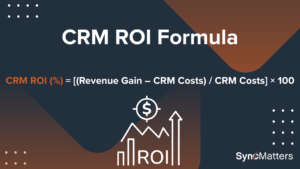
The most basic formula for calculating CRM ROI is:
ROI = (Net Profit from CRM – Cost of CRM) ÷ Cost of CRM × 100
This formula helps businesses determine the profitability of their CRM investment.
Another important method is calculating the payback period. This measures how long it takes for the CRM system to recover its implementation and subscription costs through increased revenue and efficiency.
Businesses can also analyze incremental revenue generated through CRM initiatives. This includes revenue from improved conversions, automated marketing, and customer retention improvements.
One common challenge in measuring CRM ROI is data fragmentation. When CRM is not integrated with other business systems, it becomes difficult to measure its full impact. Integrating CRM with financial, marketing, and support systems improves accuracy.
Another challenge is identifying which revenue is directly linked to CRM. Businesses should use tracking tools, analytics, and attribution models to connect CRM activities to business outcomes.
Employee adoption also affects CRM ROI. If employees do not use the system properly, businesses cannot fully benefit from CRM features. Proper training and onboarding are essential.
To maximize CRM ROI, businesses should define clear goals and track performance regularly. Monitoring key metrics allows companies to optimize workflows and improve results.
Companies should also align CRM features with business objectives. When CRM tools directly support revenue generation and customer engagement, ROI increases significantly.
Continuous improvement is essential for maximizing CRM value. Businesses should analyze performance data, test new features, and refine strategies regularly.

A real-world example shows how CRM can deliver strong returns. One company invested $120,000 in CRM implementation and generated over $615,000 in additional revenue and savings, resulting in more than 400% ROI.
Future CRM systems will rely more on AI, predictive analytics, and automation. These technologies will help businesses measure ROI more accurately and increase efficiency.
AI-powered CRM systems will also provide predictive insights, helping businesses forecast revenue and improve decision-making. This will further increase CRM value.
In conclusion, measuring CRM ROI is essential for evaluating business performance. By tracking key metrics such as customer lifetime value, acquisition cost, conversion rates, and automation efficiency, businesses can ensure their CRM investment delivers maximum value. CRM systems are not just tools—they are powerful platforms that drive growth, improve efficiency, and increase profitability.